Success is in your hand!

Showing posts with label Financial Dictionary. Show all posts

Thursday, July 14, 2022

What is FIRE? Financial Independence, Retire Early!

Through out my financial planning career, I came across many clients where more than half of them do not have a specific financial goals. Mind blowing? Perhaps not. It is more common than you could ever imagine. All they ever wanted is just to earn more money. Sounds familiar? You might be one of them too. Well, no worry, in this post I will share with you the most common financial goal that you can set for yourself too:

Financial Independence Retire Early (FIRE)

Financial Independence Retire Early

What is FIRE? 

FIRE is the short form taken from Financial Independence Retire Early. 

As per the wordings, literally, it is a movement where people have the goal of gaining financial independence and retiring early. The basic idea was to having enough saved or enough passive income to cover the expenses, in order to retire early. 


What does Financial Independence means?

Different people might have different interpretation. But personally, having enough without a day job.

At this point, you might think "Yeah, I want this too." I believe everyone would want this too, otherwise what is the point of working right? But a financial goal has to be measurable or quantifiable. So this is the part where my clients hire me to do all the calculations. 

Yes, you need to know your number. It could be the retirement number to cover the expenses for the rest of your life post-retirement. It could also be the passive income required to cover the monthly expenses. The passive income could be coming from investment's dividend, rental income, business income and so on. 

Hire me to calculate for yours too. 😉


What does Retire Early means?

Retire early could mean differently depending on the person. 

Some people it could mean never having to work anymore. After working non stop for 30-40 years, 9 to 5 every weekdays, which sums up to 56,789 hours, of course it is time to enjoy retirement right! Okay I just made up the hours number, but you get what I mean.

Then of course towards some people, early retirement simply means having enough money to retire, but they continue to do so because they are passionate in their line of work. Imagine having the power to choose not having to work anymore, like you can actually fire your boss anytime if you want! 

Similar to FI, you need to know your numbers. In this case, you need to know both your retirement number and retirement age. So yes, if you ask me, in a way, Retire Early is the same as Financial Independence. 


Is it easy to achieve FIRE?

Achieving FIRE is not easy at all, especially on the "Early" part. 

As I mentioned before, everything should be measurable. A SMART financial goal has to be time bound too. So if FIRE is one of your financial goal, then one of the question would be BY WHEN? Retire Early means before the standard retirement age of 55 or 60. So depending on your age now and also your money, I supposed you can roughly tell how easy or how difficult it would be.

Which is why you would not surprised to see some chose to work 100+ hours a week inclusive of the side jobs that they have. While some people have to do all the extreme things to save money in order to retire early. This reminds me of those TV Show like Extreme Cheapskates or Extreme Couponing. I know it could be fake but it also reminds us that not taking saving money too far.


Should You still do FIRE movement? 

Whether or not it is right for you depends on what you really want and to what lengths you are willing to go to. It is NOT impossible to achieve FIRE, but you will really have to plan it out and work it out. Like the saying goes, "WHY is more important than HOW". Hence, it is utterly important to know WHY you want to do it, which can be helpful to keep you going when you feel like giving up.

Here are some of the reasons to retire early: 

You want to pursue a passion that you can’t do while having a full-time job

You want to spend more time with family and friends

You want to have more time to exercise and be healthy

You want to have the freedom to choose what you want to do

You want to travel around the world

And many more, and perhaps some more common for Asian parents such as:

You need to help take care of your grandchildren 😅

Do you really know what you are going to do after retiring early? 

There are a lot of disadvantages too if you are retiring early, especially without planning. Early retirement does not mean sitting around doing nothing all day. It is certainly not dozing off on a cozy sofa while the TV is watching you. 

The number one con of early retirement is the declines in mental health and mobility, hence, increases in poor health outcomes, such as heart disease and stroke. Many retirees have a tough time making the transition from the daily routines of a full-time job to the unstructured life of retirement. They may find it boring and miss working, but it may not be easy to get back into the workforce once you've left it, voluntarily or otherwise.

So it is vital to decide ahead of time on what FIRE looks like for you—and how much it will cost.


Okay I know what I want, what's next? FIRE Number!

Calculations! Many FIRE movement uses simple calculation to calculate their FIRE number. Fire number can be calculated quickly but roughly. First and foremost, how much is your monthly expenses? 

The monthly expenses should include utilities expenses, rental or mortgage expenses, groceries and dining out expenses, transportation expenses, household expenses, clothing expenses, healthcare expenses, entertainment expenses and whatever you see fit.

Then multiply by 12 to get your Annual Expenses which will be frequently used to calculate FIRE number regardless which rule you wanted to follow.


What is 4% Rule (FIRE Number Rule of Thumb)?

The most common FIRE number calculation where annual expenses divided by 4%.

Fire Number = Annual Expenses / 0.04

Example: RM60,000 / 0.04 = RM1,500,000

You may ask why 4%? Where do they get the magic number of 4%? This is according to Trinity Study where 3 professors of the Trinity University wrote “Retirement Savings: Choosing a Withdrawal Rate That Is Sustainable.” So the 4% rule comes from the fact that even after 30 years of withdrawing 4% of your initial portfolio, the success rate is still 95%. So with that, the 4% rule was born!

For easier calculation, 4% Rule also known as the 25x Rule. Once your net worth exceeds 25 times of your annual expenses, (25 x RM60k = RM1.5mil) in this case RM1.5mil, then congratulations you have hit FIRE! 

The 4% Rule


RM1.5mil that's it, then I do not have to work anymore?

Roughly, yes. But not everyone follows this 4% Rule though. Some people go for 3% Rule or even less to be safe. 

A more recent study using historical market data up to 2021 to study sustainable withdrawal rates, a 100% success rate that someone with a portfolio with at least 50% in stocks could safely withdraw 3% of their investments for 40 years without depleting their investments

Another thing to keep in mind is that the research were done using S&P 500 Index and also US inflation data. So unless you are staying in US and investing in S&P 500 Index, otherwise it is always better to consult a licensed financial advisor to calculate. Bottom line, you can be more conservative by using lower withdrawal rate - 3% Rule, bigger FIRE Number will be needed.


What is Fat FIRE? What is Lean FIRE? What is Barista FIRE?

Trust me, there are many different types of FIRE out there. You can make one too, and if you succeed then it would become popular. But generally here are the differences:

Fat FIRE: hit FIRE with a higher annual expenses budget, spending over 100,000 annually

Lean FIRE: hit FIRE with a lower annual expenses budget, spending around 20,000 annually

Barista FIRE: hit FIRE but still with a part time job to cover long term benefits such as health insurance

Regardless which one you follow, always make sure you pick the one you are most comfortable with.


Okay, Any other rules that I should know?

Not rules but here are some methods the FIRE movement community follow to help them hit FIRE as soon as possible, such as:

Live minimally, live below your means

Save and invest first before you spend

Spend less than you make

Buy used cars only

Fully utilize credit card rewards 

Focus on adding multiple streams of income

Lower your tax liability by investing in tax-deferred accounts like Private Retirement Scheme


The Bottom Line...

FIRE movement can be a great financial goal, especially if you do not have any specific financial goals yet. Having a goal like that can makes you work harder and live life to the fullest instead of just running in a endless rat race. 

Start calculating your FIRE Number now! If the figure is too overwhelming, then you might look at ways to increase income or otherwise, reduce your expectation on retirement expenses. You can also talk to me by dropping a comment below or private message me in social media if you are too shy! 

Thursday, May 28, 2020

#1 Hindsight Bias | Behavioral Finance 101

What is Hindsight Bias?

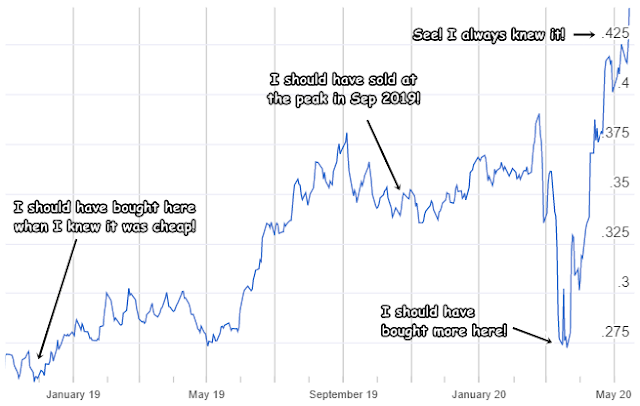
Hindsight bias is the tendency of investors to falsely believe that they predicted the outcome since the beginning, only after learning the outcome. The most common phrases would be "I knew it all along" and all the "should have" and "could have". 

Hindsight Bias
Hindsight Bias

Implication of Hindsight Bias?

In Behavioral Finance, this is one of the most common financial biases every investors would make unknowingly, which may leads to overconfident. This in turn causes them to take more unnecessary risks and trade more than they otherwise would. 

Hindsight Bias

How to Avoid Hindsight Bias?

To avoid Hindsight Bias, just follow the 4 simple steps! 
  1. Acknowledge and be conscious that everyone is vulnerable to the bias 
  2. Keep an Investment Diary
  3. Record the reasoning behind all the financial decisions in the diary
  4. Map the outcomes to the reasons and learn from both the wins and losses
It is utterly important to know, not just what happens, but why it happens regardless if is a win or a lose. With a record of all the reasoning, win can be repeated and loss can be avoided in the future. That is the best way to learn from the past, instead of relying on our biased mind. Which is why Warren Buffet always warned about investors not learning from the past in one of his favorite quote.


Stay tuned for other financial biases that we commonly made in the upcoming posts! Remember to Like, Comment and Share @YourFinanceDoctor.Henry if you find it useful!

Thursday, January 18, 2018

Net Asset Value - NAV

What is Net Asset Value - NAV?

Net Asset Value (NAV) is the value per unit of a unit trust fund or a mutual fund on a specific date. The per-unit amount is based on the total market value of all the securities in a unit trust fund's portfolio (Total Assets minus Total Liabilities) and divided by the number of units outstanding. Hence, it is the price per unit of the fund which used for subscribing (buy) and redeeming (sell). 


What is the difference with share price?

Unlike share price which fluctuates throughout the day, NAV per unit is only computed once per day based on the closing market prices of all the securities within the unit trust fund's portfolio. So, investors usually can only get to know the NAV per unit the next day. However, all the subscription and redemption order will be processed using the NAV of the Transaction Date. 

Example:
Investor A bought RM10,000 into Unit Trust X on 10/1/2018 (Transaction Date).
But Investor A can only get to know the NAV he bought on the following day, 11/1/2018. (T+1)
In other words, today you only get to know the NAV of a unit trust fund for the day before.  

What else I need to know?

Unlike share price of a share company, the NAV of a unit trust fund does not depends on demand and supply of the unit trust fund. In order to buy a share at a certain share price, one would need wait for a matching seller and vice versa. But for unit trust fund, one can always make subscription and redemption at anytime. 

From the NAV formula, only increases in Total Assets or decreases in Total Liabilities can directly affect NAV of a unit trust fund. As a result, changes in NAV are not the best gauge of a unit trust fund performance. Many other measures such as Annualized Return, Sharpe Ratio, Alpha, Beta and so on, would be much better indications of a unit trust fund performance. 


Thursday, June 1, 2017

Time Value of Money (TVM)

What is Time Value of Money?

Time Value of Money (TVM) is the concept that the value of the same amount of money available today is worth more than the value in future with the same amount of money receive. The main reason is because of INFLATION, where the value of the money is reduced in time. In other word, your purchasing power is reduced with the same amount of money comparing today and 10 years later. 


Why Understand Time Value of Money is important?

Simply because time is money! You want to fully utilize your time and money to make more money. The value of your money is decreasing every single day when you waste/procrastinate by letting them do nothing in your pocket. So what you do with the money you have NOW is utterly important! Time Value of Money can be better understand with the basic formula of calculating future value.


How to Calculate Future Value of Money?

Future value of money can be calculated by using these variables, namely present value, interest rate and number of periods. Looking at the formula, by increasing any of these variables, the future value of money will be increased too and vice versa. Which is why you have to start invest early, so that your number of periods is bigger and future value will be greater too. Greater return (interest rate) will yield higher future value too, so keeping in your pocket, keeping in bank and keeping in investment make a big difference as well!  


Example?

If you won a lottery (forget about the tax or whatsoever) and you are given a choice to choose:
Option A : Receive RM1mil now
Option B : Receive RM1mil 5 years later
Which one would you choose?

Obviously, the answer would be A, you want it now since Option B doesn't give you any extra incentive. And the same RM1mil probably not enough to buy you the same house or same land or same car or anything 5 years later because of inflation. So this is easy to choose, what about....


Option A : Receive RM1mil now
Option B : Receive RM1.5mil 5 years later
Which one would you choose?

Now, this is tricky! But actually not if you understand Time Value of Money. 

Step 1 - Find out the interest rate (return, r)
By moving around the future value formula above, we will get the number of period formula as per below. Do you feel familiar with this formula? Yes, this is indeed the same as Annualized Return where I have posted about it in previous post (read here). Simply go to Online Finance Calculator (click here) and key in all the values, you will find the Interest Rate/Annualized Return is 8.447%

PV = RM1mil, FV = RM1.5mil, n = 5, find r?


Step 2 - What will you do with the money?
Now the question is simple, what will you do with the money if you receive it now. If you are going to take the RM1mil now and put in your home (with 0 interest) or put in fixed deposit (around 4%), then you might as well choose Option B. Let's not forget that you may want to include inflation into your calculation as well. So bottom line, 8.447% should be your benchmark, unless you can beat the benchmark of 8.447%, otherwise you should always choose Option B, you want it later


If you won a lottery, probably these are not in your mind...
I bet most of you will be thinking how to spend it all away. Which is why according to National Endowment for Financial Education, about 70% of lottery winners actually end up broke within a few years. (Read here)

Well, nothing wrong with that, it's natural to want to spend money on nice things once you receive a huge amount of money. But if you do not have a proper financial plan, even for millions of dollar, you can easily lose track of how much you have spent until it is too late to realize.  


So remember, if you happen to win a lottery or receive a big inheritance, regardless of Option A or Option B, remember to hire #YourFinanceDoctor to ensure that you can spend part of the money yet keeping the rest of them to generate more money for you!  ðŸ˜‰ðŸ˜‰ðŸ˜‰

Monday, April 24, 2017

Annualized Return

What is Annualized Return?


Annualized Return is the geometric mean return of an investment provides over a period of time and expressed in a time-weighted annual percentage. It shows what an investor would earn over a period of time if the annual return was compounded. The Annualized Return is measured against the initial amount of the investment and represents a geometric mean rather than a simple arithmetic mean. 

Why used Annualized Return?

Annualized Return, also known as Compound Annual Growth Rate (CAGR), is more accurate than a simple return, as it includes the compounding interest, while simple return just simply add up all the returns without the time-weighted factor. Hence, this makes it one of the best measures when various type of investments are being compared.  


How to Calculate Annualized Return?


Example?

Client A invested RM100,000 on Unit Trust Fund A with #YourFinanceDoctor on Jan 1, 2007. Assume that Client A would like to sell on Jan 1, 2017 for RM200,000. Client A also receives a total of RM50,000 in dividends over the ten-year holding period. So ending value of investment will be RM250,000 while beginning value of investment will be RM100,000 over 10 years.

Annualized Return = ((250,000/100,000)^(1/10)) - 1 =  9.60%

Simple Return = ((150,000/100,000) x 100%) / 10 = 15%


A Simple Return of 15% a year would seems like a very good investment but in fact the Annualized Return is only 9.60%! (Which is still a good return tho!) Simple Return is commonly used in promotional materials for investments, so beware not to be mislead-ed and always ask for the Annualized Return!


Henry Tan - Your Finance Doctor © 2014. All Rights Reserved | Powered By Blogger | Blogger Templates | Designed by-Dapinder

UA-40859242-2